• ROMARCH: Pathways of Communication Conference in Ankara

    PATHWAYS OF COMMUNICATION: ROADS AND ROUTES IN ANATOLIA FROM PREHISTORY TO SELJUK TIMES

    Ankara University

    Organized by the British Institute of Archaeology at Ankara

    20-22 March 2014

    Information: http://pathwaysofcommunication.wordpress.com

    Click for Registration (spaces are limited)

    A description from the Call For Papers:

    Continue reading

  • ROMARCH: Call for Participants, Excavations at Roman Carsulae (Italy)

    Excavating the Baths at Carsulae

    EXCAVATIONS OF THE BATHS AT ROMAN CARSULAE (ITALY)
    June 8 – July 19, 2014
    We are now accepting applications from students and volunteers to participate in our ninth season of excavations of the baths at Roman Carsulae.
     
    Project and Location  
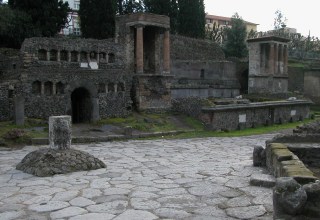
    The Roman city of Carsulae, founded in the third century BCE along the Via Flaminia in modern Umbria, was extensively excavated by the Soprintendente for Umbria, Umberto Ciotti, from the 1950s to the 1970s.  He uncovered a number of its public buildings including the forum, amphitheatre and theatre and transformed the entire area into an archaeological park.  In 2004, our team, under the direction of Jane K. Whitehead and the Soprintendenza per i Beni Archeologici dell’Umbria commenced a longterm project to re-excavate the baths, which are located just south of the city limits and were left exposed after Ciotti’s excavation 40 years earlier.
    In 2011, we received grants from Italian sources, in particular the Associazione Valorizzazione del Patrimonio Storico,which enabled us to construct a roof over the remains of the baths.  Because it affords greater protection from the elements, during the 2012 and 2013 seasons we were able to open up areas that were more fragile, thus further exposing the structure. 
    We plan to dedicate our 2014 season to excavating the remainder of the areas beneath the protective roof as well as the region immediately to the east, where in recent years we have uncovered more rooms.   We will also collaborate with our colleagues with the San Gemini Preservation Studies program and the Soprintendenza on a plan for the conservation of the bath building.
  • ROMARCH: Liverpool Research Day: Pompeii

    cover05
    MEDITERRANEAN ARCHAEOLOGY RESEARCH DAY

    Pompeii

    POSTPONED
    (further information will be posted when it becomes 
    available)

    Saturday 15th February 2014

    The Gallery, Foresight Centre, University of Liverpool

    Pompeii is the most iconic city of the ancient world and has come to stand as a symbol for the ancient world in the popular imagination and contemporary media. However, there is still much that we do not fully understand about this most famous of archaeological sites and exciting new research directions are taking seek to contextualise our understanding of Pompeii as a living community within its contemporary Roman context as well as an enduring emblem of the achievement of Roman culture and the destructive power of nature.

    Aimed at researchers, learners and the general public, this day consists of lively illustrated lectures on all aspects by leading international researchers on their latest research into ancient Pompeii and modern perceptions of the city and its cultural legacy. Papers cover aspects of history, archaeology, geology and the reception of Pompeii by contemporary societies. There will also be a hands-on demonstration of Roman artefacts during the break.

    To book a place online go to: http://payments.liv.ac.uk/browse/extra_info.asp?compid=1&modid=2&deptid=38&catid=45&prodid=190

    <see below for the full programme>

    Continue reading

  • Castel Rigone, Week 22: Royalty

    Re-blogging from Shades of Umbria, 3 Feb. 2014. This is the 15th in a series of posts on the ethics of competition, focusing on Castel Rigone Calcio, and part of the ‘Ethics of Combat‘ category on quemdixerechaos. This blog series completes a DePauw University Faculty Fellowship that examines how and why rules and customs develop for, and in, combat and competition.

    Pedar W. Foss's avatarShades of Umbria

    The sun was shining in Perugia on Saturday afternoon, but above Lake Trasimeno clouds and mist prevailed. In a parallel struggle at the edge of the sod and mud, visiting tifosi tried to lift the atmosphere, spreading red-and-yellow banners (and one flag), and calling out their songs to the tunes of ‘Aida’, ‘The Entertainer’, and even ‘God Save The Queen’. Poggibonsi’s English aspirations even extended to one of the supporters’ groups, ‘Old Lion‘. Their team had not lost in six games.

    The home side were not sporting color; with the stewards in their usual light-grey Cucinelli slacks and charcoal pea coats, and the fans in dark winter gear, the mood was tense and uncertain. Castel Rigone had lost its last three matches.

    The pitch had been vacuumed of water, but more was to come — not long after the opening whistle, the skies opened up. The morass…

    View original post 888 more words

  • Castel Rigone, Week 21: What Comes Around

    Re-blogging from Shades of Umbria, 28 Jan. 2014. This is the 14th in a series of posts on the ethics of competition, focusing on Castel Rigone Calcio, and part of the ‘Ethics of Combat‘ category on quemdixerechaos. This blog series completes a DePauw University Faculty Fellowship that examines how and why rules and customs develop for, and in, combat and competition.

    Pedar W. Foss's avatarShades of Umbria

    Two long shots stretch the netting inside the goal. One skids almost 30 yards along the ground, denting the tips of weary grass and divots of mud. The keeper Zucconi, just entered as a substitute, positions himself on the right side, but — his view shielded — he dives too late, eyes shoving his head back as he twists to watch the ball skid past. The other steams nearly 40 yards into the upper right corner as Zucconi flies helplessly past. Both come off the feet of a 22-yr. old Portuguese no. 10, Pedro Miguel Costa Ferreira, who was shooting at nearly every opportunity, and whose persistence (or selfishness) paid off in the second half for A.C.R. Messina in their 2-0 defeat of Castel Rigone. The YouTube highlights of the game (below) have now had more views than the 1000 who watched the match in a stadium that holds nearly…

    View original post 571 more words

  • Castel Rigone, Weeks 19-20: Bumps

    Re-blogging from Shades of Umbria, 23 Jan. 2014. This is the 13th in a series of posts on the ethics of competition, focusing on Castel Rigone Calcio, and part of the ‘Ethics of Combat‘ category on quemdixerechaos. This blog series completes a DePauw University Faculty Fellowship that examines how and why rules and customs develop for, and in, combat and competition.

    Pedar W. Foss's avatarShades of Umbria

    Since Shakespeare‘s day, ‘bump‘ has meant a protuberance, something raised above the normal level. In a road, a bump forces one to slow down. During an election, a bump is more like a bounce. In the late 20th century, as data visualization became more common, words were commandeered to describe meaningful patterns or events. For instance, a significant change in a graphic trend-line (since at least 1980) became a ‘bump’ in the polls. Soccer has good and bad bumps too.

    Received wisdom says that when a team fires its manager, almost always because of poor results, the team revives, plays better, and often wins its next game, or several games. In other words, the team will enjoy a positive ‘bump’. The general reasoning is that players, wishing to impress the new manager, will try harder to keep their place on the squad, or earn the favor of…

    View original post 695 more words
