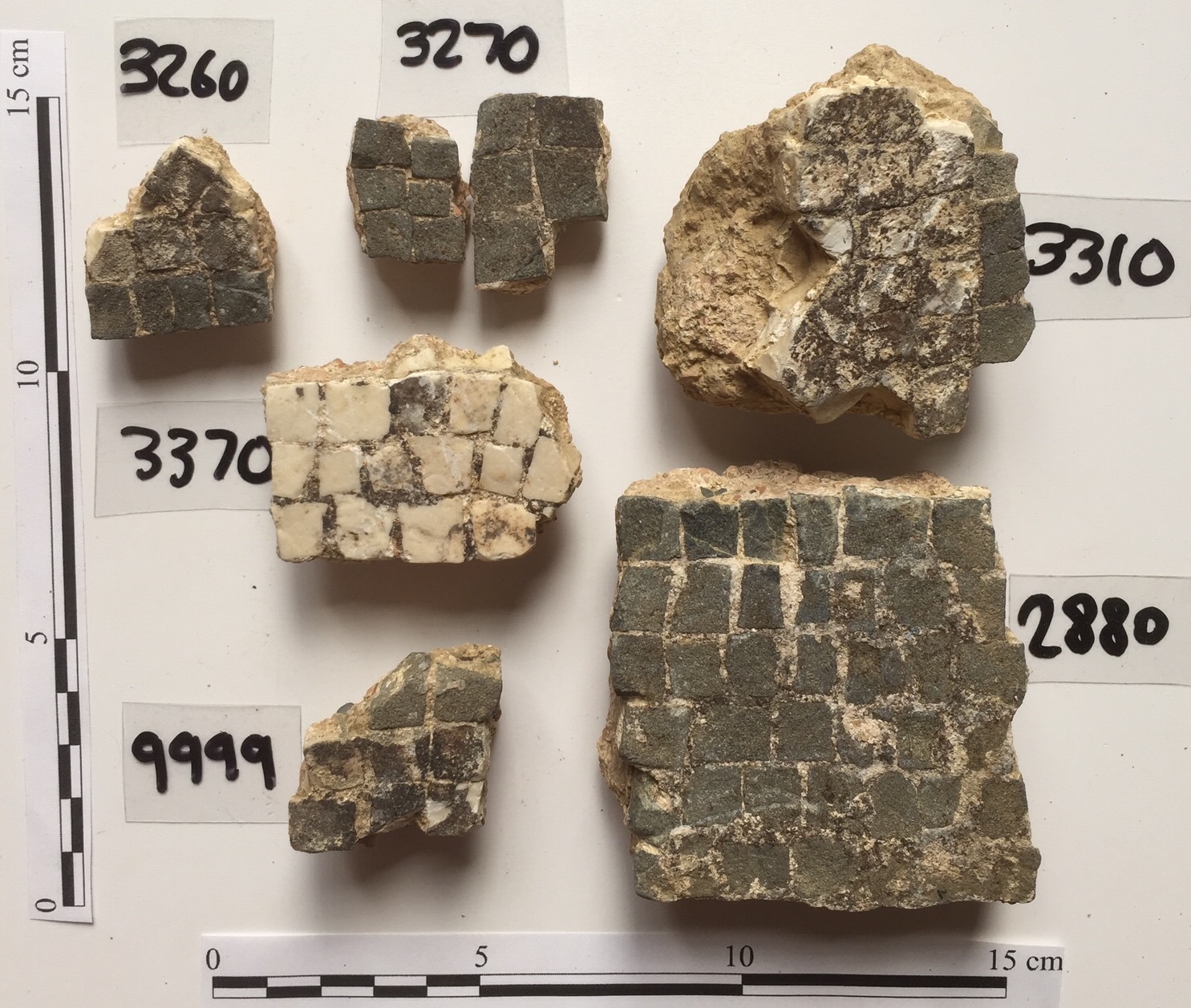
Please note this excavation project in the south of Portugal, during June 2018, digging in Castelo Velho de Safara, an Iron Age site.
See the flyer below for information, and/or check the website at www.swarchaeologydigs.com
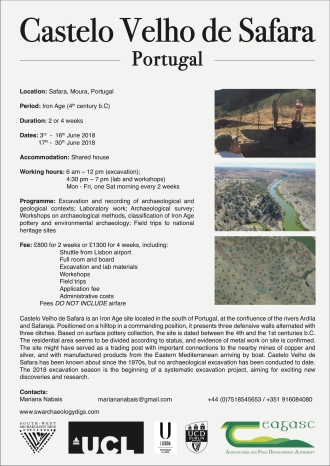

Please note this excavation project in the south of Portugal, during June 2018, digging in Castelo Velho de Safara, an Iron Age site.
See the flyer below for information, and/or check the website at www.swarchaeologydigs.com

The Trasimeno Archaeology Field School of the Umbra Institute in Perugia provides a curricular concentration in Archaeology and History based in Castiglione del Lago on the shores of Lake Trasimeno between Umbria and Tuscany.
The Excavation Site
The fieldwork takes place on an archaeological area located on the shores of Lake Chiusi, on the Umbrian-Tuscan border just a few miles from Castiglione del Lago and Lake Trasimeno. On fieldwork days, a bus will take students, faculty, and staff to the site for a full-day’s work and research. Lunch will be on-site, and students will return home in the mid-afternoon. Alternating days will be spent in class, at the local museum, or on field trips to nearby sites of interest. This archaeological site was only recently discovered and this project is the first scientific investigation. After a season of survey and two seasons of excavation, findings indicate the presence of a 2nd-c BC-3rd c. AD Roman villa, including a bath complex, tile manufacturing, and a possible Roman road. The Archaeological Field School is a long term project run in cooperation with local institutions. Every summer, students contribute to the uncovering of the site and the display of artifacts in the expanding archaeological museum of Castiglione del Lago.
The Town
Castiglione del Lago is a charming medieval town in Umbria, located on top of a small peninsula along the southwestern shores of Lake Trasimeno. It featured in a recent article by The Guardian as one of the best lakeside towns in Europe. A member of the prestigious I Borghi più Belli d’Italia Association (The Most Beautiful Villages in Italy, www.borghitalia.it), Castiglione lies among renowned historical cities, such as Orvieto, Chiusi, Arezzo, Cortona and Perugia. All Field School participants stay in Castiglione during the summer term, only a few miles away from Perugia and easily accessible either by bus or train.
The Academic Program
The Field School consists of two courses, one theoretical and one practical, both held in Castiglione del Lago. The program aims to provide students with a comprehensive overview of up-to-date theories and methods of archaeological research and fieldwork as applied to the civilizations that shaped the history and culture of central Italy. The Field School runs for 6 weeks. Program dates for the summer 2017 will be May 26th (arrival in Italy) to July 7th (departure).
The course ARFW 350: Archaeological Field Workshop is an archaeology practicum. Students will work alongside professional archaeological staff to gain fundamental skills in archaeological research and apply them to the project.
Course Credit: 3
The course ARCL 340: Archaeology in Central Italy: The Etruscan and Roman Heritage, introduces students to the region’s history and heritage, and provides context for the archaeological research project.
Course Credit: 3
Both courses are non-prerequisite and mandatory. They include fieldtrips to various archaeological and cultural sites, including an overnight trip to Rome. Fieldtrips are designed to enhance student understanding of the territory’s history, while also providing the opportunity to study and visit neighboring archaeological sites and major museum collections.
Click on the host website: http://www.umbra.org/academics/archaeology-summer/
Or visit the project blog, including links to publications: https://archaeotrasimeno.wordpress.com

The Late Antique Archaeology conference reviews the state of late antique funerary practices, on a thematic basis, from scientific examinations of skeletons and their DNA, to treatments of the deceased body, to the nature of memorial structures and how they were treated over time.
SCHEDULE:
(A) DEMOGRAPHY
(i) OSTEOLOGY: LATE ANTIQUE LIVES FROM BONES
09.45-10.45 Flavio de Angelis (Sop. Arch. Di Roma) and Andrea Battistini (Sop. Arch. Di Roma) Lives from Bones: Anthropological Evaluation in the City of Rome
(ii) BIOMOLECULES IN LATE ANTIQUITY (ISOTOPES, DIET, MIGRATION, EPIDEMIC, ENDEMIC DISEASE)
11.00-11.30 Alexandra Chavarria (Padova) Northern Italy
11.30-12.00 Mathew Emery (McMaster) Southern Italy (via Skype)
(B) RITUALS AND IDENTITIES: DEATH RITUALS AND TREATMENT OF THE BODY
12.15-12.45 Rhea Brettell (Bradford) Organic residues from mortuary contexts (Britain).
12.45-13.15 Thibaut Devièse (Oxford) Colourants and dyes
Respondant: Béatrice Caseau (Paris IV) Treatment of the body: Ointments and perfumes
(C) COMMEMORATION, MONUMENTS, FUNERARY TOPOGRAPHY
(i) MEMORIALS – LATE ANTIQUE COMMEMORATION,
14.00-14.30 Zsolt Magyar (?Budapest) Mausolea in Pannonia
14.30-15.00 Chris Sparey-Green (Kent) Mausolea in NW Europe
(ii) SPATIAL RELATIONSHIPS OF DEAD TO LIVING
15.15-15.45 Judit Ciurana Prast (Barcelona) Funerary Landscapes of Catalonia
15.45-16.15 Efthymios Rizos (Oxford) Christian elite burials in Anatolia / Constantinople & the cult of relics
(iii) MEMORIAL AND OBLIVION: SPOLIA AND ATTITUDES TO TOMBS
16.30-16.45 Luke Lavan (Kent) Spolia and the archaeology of memory
16.45-17.15 Douglas Underwood (Kent) City walls and tomb destruction (Skype)
17.15-17.45 Nick Mishkovsky (Kent) City walls and tomb preservation
17.45-18.00 Conclusion.
Date: Saturday, 17 March, 2018
All are welcome. Admission 25 GBP, 10 GBP Students.
Registration is via Eventbrite: https://laaburial2018.eventbrite.co.uk
Venue: Room 421 inside Birkbeck College, University of London, Malet Street, Bloomsbury, London WC1E 7HX. Metro: Russell Square.
Conveners: L.Lavan/M.Mulryan (Kent) T.Penn (Edin.) R,Darley (Birkbeck).
Sponsors: University of Kent, Birkbeck (University of London), J.Beale, Brill.
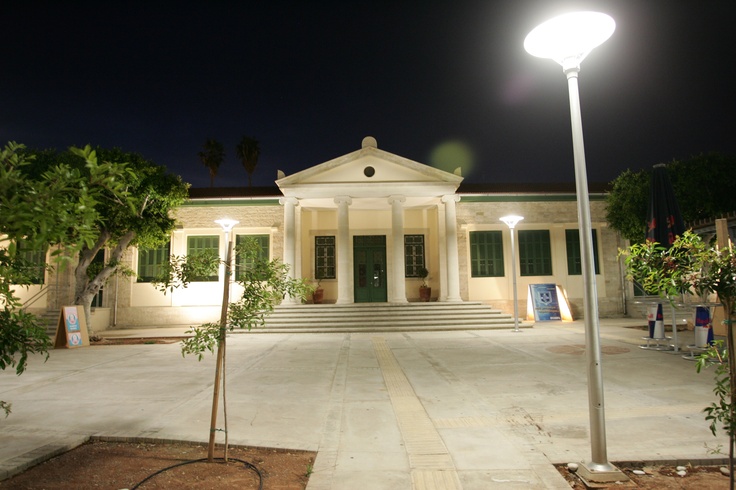
On behalf of the organizing committee of the CAA-Gr 2018 conference to be held in Limassol on 19-20 June 2018, I would like to inform you that the submission deadline has been extended until February 15th. The same date applies to those who want to organize a workshop on June 18th.
More information can be found at the conference website https://www.caa-gr2018.org/
You can submit your paper here: https://openconf.caa-gr2018.org/openconf.php
For any information please do not hesitate to contact us through conference@caa-gr2018.org or regarding papersubmissions at submissions@caa-gr2018.org
Concerning registration and accommodation, please contact smartevents@cytanet.com.cy
On behalf of the CAA-Gr 2018 organizational committee
——————————————————-
Αγαπητοί συνάδελφοι,
Εκ μέρους της οργανωτικής επιτροπής του CAA-Gr 2018, το οποίο θα διοργανωθεί στη Λεμεσό στις 19 και 20 Ιουνίου 2018, θα ήθελα νασας ενημερώσω ότι έχει δοθεί παράταση υποβολής εργασιών μέχρι και τις 15 Φεβρουαρίου.
Σας υπενθυμίσω για τη δυνατότητα όπως διοργανώσετε στα πλαίσια του συνεδρίου θεματικό εργαστήριο (workshop)στις 18 Ιουνίου. Γιαοργάνωση workshop, παρακαλώ όπως υποβάλετε το προτεινόμενο θέμα και πάλι μέχρι τις 15 Φεβρουαρίου.
Περισσότερες πληροφορίες μπορείτε να βρείτε στην ιστοσελίδα του συνεδρίου https://www.caa-gr2018.org/
Για υποβολή εργασιών: https://openconf.caa-gr2018.org/openconf.php
Για οποιεσδήποτε πληροφορίες μπορείτε να στείλετε ηλεκτρονικό μήνυμα στο conference@caa-gr2018.org
Για θέματα που αφορούν την υποβολή εργασίας αποτείνεστε στο submissions@caa-gr2018.org
Θέματα που αφορούν την εγγραφή στο συνέδριο και διαμονή μπορείτε να στείλετε ηλεκτρονικό μήνυμα στοsmartevents@cytanet.com.cy
Εκ μέρους της οργανωτικής επιτροπής CAA-Gr 2018
——————————————————–
Professor Vasiliki (Lina) Kassianidou
Director, Archaeological Research Unit
Archaeological Research Unit, Department of History and Archaeology
UNIVERSITY OF CYPRUS
P.O. Box 20537. CY-1678 Nicosia, CYPRUS
tel. +357 22 893564, FAX. +357 22 22895489
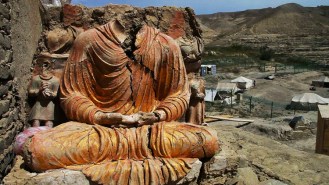 Saving Mes Aynak: Special Film Showing and Interview with Brent Huffman
The extraordinary Silk Road archaeological site of Mes Aynak, 25 miles south-east of Kabul is one of the largest and most important in Afghanistan, and includes extensive remains of Buddhist art and architecture from the first millennium. But the vast copper deposits beneath the site, which contributed to its ancient prosperity, also represent a phenomenally valuable resource for a a modern country in need of investment, and in 2007 the site was leased to the China Metallurgical Group for £3 billion.
Following the rescue excavations that ensued and some of the personalities involved with the site, Brent E. Huffman’s multi-award-winning 2014 documentary, Saving Mes Aynak, focused international attention on the threat to the archaeology and the tensions surrounding it.
As part of our Gandhara Connections project, supported by the Bagri Foundation and the Neil Kreitman Foundation, the Classical Art Research Centre is delighted to announce a special Oxford screening of Saving Mes Aynak, followed by an interview with the director, which will highlight recent developments and probe some of the complexities of the site’s predicament.
Thursday 8th March 2018, 5-7pm, followed by a reception.
Ioannou Centre, 66 St Giles’, Oxford OX1 3LU.
All are welcome and the event is free, but please email us to book a place at carc@classics.ox.ac.uk
 Classical Art Research Centre Workshop 2017
Oxford, 28-29th September, 2017
Transmission: The Migration of Iconography in Classical Art
Generously supported by Jean-David Cahn and Tony Michaels
UPDATE: We are very pleased to announce the podcasts from our workshop ‘Transmission: The Migration of Iconography in Classical Art’ are now online.
You can view these alongside other videos from our expanding library of recorded events here: http://www.beazley.ox.ac.uk/tools/podcasts.htm
One hallmark of Greek and Roman art is the persistence of certain schemes of imagery and their movement between media and across space and time. For example, certain compositions of figures or mythological scenes, invented at particular times and places, enjoyed an extraordinary longevity and were reproduced across and beyond the Graeco-Roman world. The phenomenon is especially notable in the period of the Roman Empire, when the conditions of Roman rule enabled particular scenes and motifs to spread through Europe, the Mediterranean, and the Middle East.
This is not only a matter of individual figure types, gestures, iconographical attributes etc, the vocabulary of Graeco-Roman art. Often elaborate compositions were transmitted with a high degree of consistency through the traditions of painting, relief sculpture, mosaics, illustrated manuscripts, and the applied arts. Some mythological vignettes survived through many generations of artistic production and crossed from one medium to another. Some popular non-narrative scenes, like the so-called Totenmahl or ‘funerary banquet’ used in Hellenistic and Roman funerary art, also enjoyed popularity for centuries.
In trying to understand such movements of imagery we have to discern them through fragmentary evidence and the processes are often unpredictable and obscure. Small, apparently incidental details may be faithfully reproduced across vast chronological and geographical spans, while in other ways the imagery is adapted to suit the purposes of those who made or used art in specific circumstances. This tension between the local purposes of ancient works of art and the big picture of the classical tradition, visible to the ‘all-seeing’ archaeologist offers an excellent opportunity for understanding how classical art worked at different levels of analysis. Yet much remains obscure about the particular mechanisms by which iconography was transmitted, whether through artistic training, artists’ imitation of portable objects, or the hypothetical models known as ‘copy-books’ or ‘pattern-books’, which are often assumed to have existed, but for which there is little hard evidence.
This workshop builds upon CARC’s recent events dedicated to Roman replicas and Greek artists. Through the contributions of international speakers and lively, informal debate, it will aim to cast new light on ancient imagery and on the lessons that can be learned from examining its adaptive success. The workshop will focus on mythological scenes (but not exclusively) and on Hellenistic and Roman periods (but not exclusively). Probable topics for discussion include: the evidence for and against ‘copy-books’; the transmission of imagery between luxury art and stone reliefs such as Roman mythological sarcophagi; the role of ceramics and plaster models as vehicles for transmission; mythological mosaics; the movement of imagery across Roman provinces; and the persistence of classical schemes in the illuminated manuscripts of Late Antiquity.
Download The Abstract: www.beazley.ox.ac.uk/events/Transmission%20Abstract.pdf
All are welcome! The workshop will be free, but it is necessary to book in advance by contacting carc@classics.ox.ac.uk
—
Giles Richardson
Administrative Assistant, Classical Art Research Centre
University of Oxford
Ioannou Centre for Classical and Byzantine Studies
66 St Giles’, Oxford, OX1 3LU
Tel: +44 (0)1865 278082
Fax: +44 (0)1865 610237
 Michael Wood: Travelling and Filming in Gandhara
Leonard Wolfson Auditorium, Wolfson College
5.00pm, Thursday 23rd November 2017
The historian and broadcaster Michael Wood will be giving the 2017 Gandhara Connections public lecture. The lecture will take place at 5pm on Thursday 23rd November 2017, in the Leonard Wolfson Auditorium, Wolfson College, Oxford (followed by a reception). We plan to record the lecture and make it available online as a podcast. Attendance is free and all are welcome, but please book a place by emailing us at carc@classics.ox.ac.uk
Michael Wood, who is currently Professor of Public History at the University of Manchester, has been responsible for a number of the most celebrated historical documentary series in recent decades, including In Search of the Trojan War (1985), In the Footsteps of Alexander the Great (1997), The Story of India (2007), and most recently, The Story of China (2016).
Prof Wood will be speaking about Gandhara and his experiences of travelling and filming in the region over thirty years (including film clips).
—
Classical Art Research Centre
www.carc.ox.ac.uk/GandharaConnections
Ioannou Centre for Classical and Byzantine Studies
66 St Giles’, Oxford, OX1 3LU
Tel: +44 (0)1865 278082
Fax: +44 (0)1865 610237
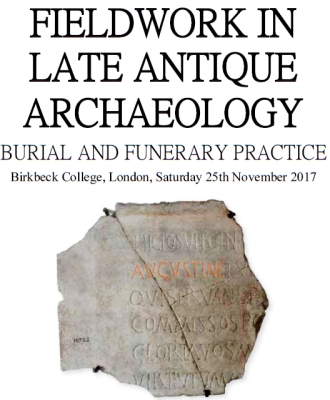 *FIELDWORK IN LATE ANTIQUE ARCHAEOLOGY 2017*
*BURIAL AND FUNERARY PRACTICE*
Birkbeck College, London, Saturday 25th November 2017
<announcement courtesy of Michael Mulryan>
This seminar reviews the state of funerary archaeology across the late antique world, providing an up-to-date overview of the latest discoveries in the field and in the lab, organised in terms of a series of regional portraits, from the cemeteries of Britain to the caves of Egypt.
Exploring Roman food, memory & identity
DePauw Winter Term 2015-2017
TOGETHER TO THE TOP
It all begain when our family of four relocated from Vashon, WA to Canterbury for a year
Through Young Eyes
Professional Soccer Coaching Advice features free tips, tools, sessions and advice from Premier League and grassroots coaches.
Living in Italy with my family
an archaeology of landscapes, mindscapes, and playscapes
an archaeology of landscapes, mindscapes, and playscapes
Ambling through the present and past with thoughts about the future
an archaeology of landscapes, mindscapes, and playscapes
an archaeology of landscapes, mindscapes, and playscapes
The TED Blog shares news about TED Talks and TED Conferences.
an archaeology of landscapes, mindscapes, and playscapes
 [quem dixere chaos]