
The New York Times on Mar. 2, 2025 ran a story about attempting to fix the precise date of the eruption of Vesuvius in AD 79:
https://www.nytimes.com/2025/03/02/science/volcano-vesuvius-pompeii.html
They consulted with me on the story, and I’m glad to see they represented the arguments and evidence pretty fairly. This fall I’ll be delivering a keynote address at an international colloquium on the topic:
21-23 Nov., 2025, Sorrento and Pompeii:
ERA D’AUTUNNO, IO NO, NUN MME NE SCORDO
79 d.C. questioni di metodo e di umanità
convegno internazionale intorno all’eruzione del Vesuvio
“IT WAS AUTUMN, I DON’T, I NEVER FORGET ABOUT IT
79 AD questions of method and humanity
international conference on the eruption of Vesuvius.”
There’s a call for papers for the colloquium that closes on 15 March. Here’s the circular:
Category Archives: Archaeology
-
-
Director General of Pompeii supports Aug. 24 date for the Eruption of Vesuvius in AD 79

Published today, an article led by Gabriel Zuchtriegel, Director General of the Pompeii Archaeological Park:
It’s a review of recent work on the question of the eruption date; thanks to Dr. Zuchtriegel for asking me to review and comment on the article just a few weeks ago, prior to its publication. The article was picked up across the Italian media today and has made it to the Guardian.
Even though Dr. Zuchtriegel attributes my work immediately in his article, none of these press notices have mentioned Pliny and the Eruption of Vesuvius, my 2022 book that bucked the recent trend of trying to date the eruption to later in the autumn of AD 79. My manuscript research, which I first began to work out on this blog site, has now been generally accepted as demonstrating that Pliny wrote Aug. 24 as the eruption date, and not anything else. If you want to know more details about the evidence and arguments at play, check out my other posts on this site about Pliny and the Eruption, or consult the book. As always, I am open to any new, well-documented evidence that may come to light.
You can also see the arguments yourself, in a lecture I delivered this fall courtesy of Prof. Robert Holschuh Simmons and Monmouth University, the the 8th annual Thomas and Anne Sienkewicz Lecture on Roman Archaeology (thanking them for the invite, and the recording):
-
Two Reviews of the Two Plinys and Vesuvius
Two reviews of Pliny and the Eruption of Vesuvius have come out, one by Margot Neger in BMCR, and one by Paolo Bernardini in La Provincia di Como (here is the PDF and a translation). I should note that the Addenda et Corrigenda on the publisher’s website has also been updated, in order to address the few but unfortunate errors in the text; thank you to colleagues and reviewers for pointing those out.
-

ROMARCH: Rome: City and Country; U. Reading Symposium, 11 May
Rome: City and country
A symposium in honour of Professor Annalisa Marzano
Department of Classics, University of Reading
11th May 2022, 2-5 PM
Programme
2.00 – 2.20
‘Introduction’
Barbara Goff and Amy Smith, University of Reading
2.20 – 2.40
‘Big data in the Roman countryside: The Roman Hinterland Project’
Rob Witcher, Durham University
2.40 – 3.00
‘Picking up the pieces’
Wim Jongman, University of Groningen
3.00 – 3.20
Break
3.20 – 3.40
‘Quantifying the built environment of Rome’
Jack Hanson, University of Reading
3.40 – 4.00
‘Recent research in South-East Rome: An introduction to the Rome Transformed Project’
Ian Haynes, Newcastle University
4.20 – 4.40
‘The Augustan horticultural revolution’
Annalisa Marzano, University of Reading
The event will be held both in person and online.
The link for joining the event remotely is as follows: https://teams.microsoft.com/l/meetup-join/19%3ameeting_NWJlNGJjNmYtOGM0NS00N2M3LWE0ODMtOGZhY2I5NmEzZDM4%40thread.v2/0?context=%7b%22Tid%22%3a%224ffa3bc4-ecfc-48c0-9080-f5e43ff90e5f%22%2c%22Oid%22%3a%22ab142154-1453-4d9e-93ec-c6a8991e6c42%22%7d
For more details, please contact Dr J. W. Hanson at j.w.hanson@reading.ac.uk.
-
Herculaneum Society: Pliny the Younger and the Date and Sequence of the Vesuvian Eruption
Two talks for the Herculaneum Society, based at Oxford, 26 February 2022, now on YouTube:
- Professor Pedar Foss, DePauw University, on “Ashy Tuesday-Wednesday: The Date and Sequence of the AD 79 Eruption;”
- Professor Roy Gibson, Durham University, on “From Como to the Bay of Naples: Pliny’s Epistolary Italy.”
-

The Date of the AD 79 Vesuvius eruption in the textual sources
20-min. lecture from 6 January 2022, Archaeological Institute of America Annual Meeting. All details and data to be published in March 2022: https://www.routledge.com/Pliny-and-the-Eruption-of-Vesuvius/Foss/p/book/9780415705462
Three clarifications/corrections:
1) @ 3:40, when I say that gamma comprises 95% of extant Plinian manuscripts, I should have specified that this was 95% of all extant Plinian manuscripts that contain the Vesuvian letters.
2) @11:20, the date of Biondo’s ms. should be ca. 1424-25.
3) @12:05, I think that mss. c and q have a ‘nou’ with a long macron reading because c° contained both the ‘non’ (with a long macron) from Valla, and also the ‘nou’ from R1472, and either in that ms. or in its descendants, scribes were trying to reconcile those two options. Mss. c and q were both presentation copies (and have a number of errors), so their scribes were just trying to copy in a nice way what they saw in their exemplars, c° and q°. They weren’t necessarily trying to construe ‘November’, though that is a possibility. In either case, ‘November’ was not present in some dusty ancestor. It was contrived first, explicitly, by the r-editor in R1472–} r°.
-
Pliny and the Eruption of Vesuvius – publication March 2022
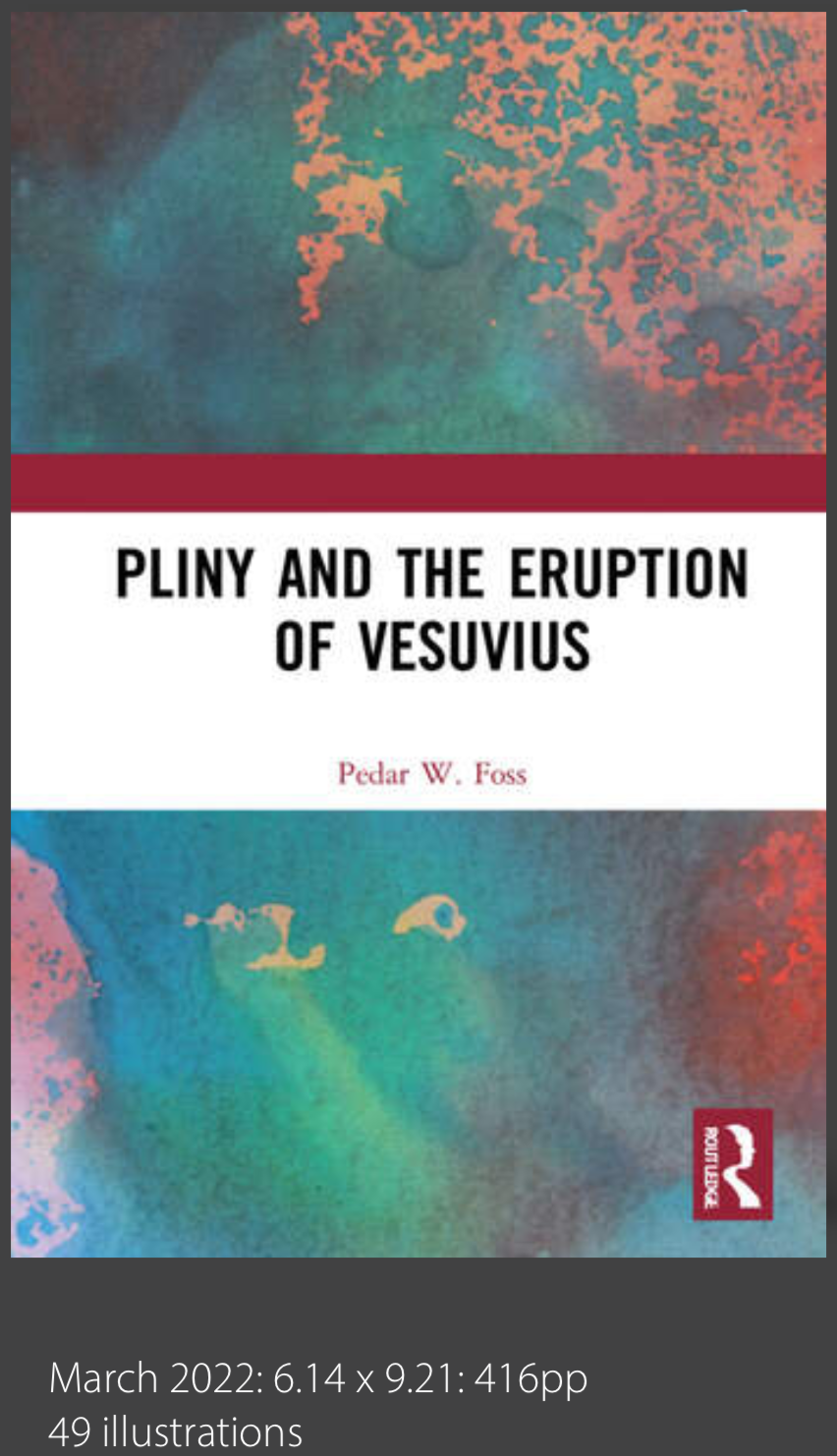 Pliny and the Eruption of Vesuvius (Routledge, March 2022) is in press. Here is how to order for your library at a 20% discount. My blog posts about the Vesuvius eruption are well obsolete, but I will leave them as-is for archival purposes. The book is about Letters 6.16 and 6.20, and contains these chapters:
- Two Plinys: Short biographies of the Elder and Younger Pliny, setting the context for the Vesuvian letters.
- Two Letters: A reconstruction of the transmission history of Epp. 6.16 and 6.20 within the context of the whole manuscript tradition of the Epistulae. This is based on the collation of every known and available extant manuscript and early printed edition of the text of those letters (which has never been done before).
- Two Days: A reconstruction—based on the latest volcanological studies and a new complete GIS model of the AD-79 topography of the Bay of Naples—of the eruption sequence, its effects upon the landscape and people of the Bay of Naples, and how those new studies enlighten the accounts in Pliny’s Epistulae, including the likely location of the Pliny’s villa from which the eruption was first spotted. In addition, this chapter treats the date of the eruption, both in the manuscript tradition, and in the archaeological evidence. It shows, among other things, how ‘November’ crept into the manuscript tradition as an error, how that error was propagated, and why the textual tradition cannot be used as a basis for arguing that the eruption happened in October or November, despite the repeated citation of problematic 17th-/18th-c. scholarship and recent press favoring a non-August date.
- Epistulae 6.16, The Elder’s Story: Text, textual variants, new translation, and detailed commentary.
- Epistulae 6.20, The Younger’s Story: Text, textual variants, new translation, and detailed commentary.
Routledge will also host the data files behind the arguments in their Online Resources. Those will include:
- A side-by-side continuous Latin and English translation of Epp. 6.16, 6.20, including the collation markers (PDF).
- Ep. 6.16 Inventory of Sources and Collation (Excel spreadsheet).
- Ep. 6.20 Inventory of Sources and Collation (Excel spreadsheet).
- Epp. 6.16 and 6.20 Collation “Fingerprints” — the key readings that decipher the manuscript tradition (Excel spreadsheet).
- Select Collation of Epp. 1.8, 12, 23-24 — key readings to understand the manuscript tradition for Epp. 1.1-5.6 and the F source (PDF).
- Select Collation of Book 8 Letters — key readings to understand the manuscript tradition for the theta branch of the manuscript tradition (PDF).
- Collation Encoding Key (how manuscript abbreviations in items 2-6 are encoded in the collation spreadsheets) (PDF).
- Continuous Color Diagram for the Manuscript Tradition (PDF).
- Continuous Halftone Diagram of the Eruption Sequence (PDF).
- Geographic Information System (GIS) of the pre-eruption Bay of Naples in AD 79 (ArcGIS folder).
Please cite my work appropriately. Thank you.
-
Summer 2022 Program Opportunities in Greece
The American School of Classical Studies at Athens was founded in 1881 to provide American graduate students and scholars a base for their studies in the history and civilization of the Greek world. Today it is still a teaching institution, providing graduate students a unique opportunity to study firsthand the sites and monuments of Greece. The Summer Session and Summer Seminars allow students, scholars, and teachers to experience Greece first-hand with on-site learning.
Scholarships Available for All Programs (for Graduate Students and Teachers)
2022 Summer Seminars
Eighteen-day sessions designed for those who wish to study specific topics in Greece and visit major monuments with exceptional scholars as study leaders, and to improve their understanding of the country’s landscape, history, literature, and culture. Choose one, or both(!), seminars – seminar topics change every summer.
Aegean Networks of Technology (June 6-24, 2022)
This seminar will explore four fundamental technologies in ancient Greece (ceramics, wood-working, stone carving, and bronze-casting) and how craft practitioners shared their expertise in multi-craft projects, such as building a boat or a temple. Participants will discover how these networks of technology developed in a broad Aegean context, from Athens and Corinth on the mainland to the Cycladic islands of Naxos, Paros, and Santorini, and in a deep time frame, from prehistory to contemporary traditional practices. Taught by Professor Eleni Hasaki, University of Arizona.The Northern Aegean: Macedon and Thrace (June 30 – July 18, 2022)
In this seminar, participants will explore the Northern Aegean region during various time periods. The history of Macedon and Thrace bridges the East and West and offers a glimpse into some of the most significant developments in Greek history, such as colonization, cross-cultural relations, the Persian Wars, Athenian hegemony, and the rise of Macedon. Taught by Professors Amalia Avramidou, Democritus University of Thrace, and Denise Demetriou, University of California, San Diego.2022 Summer Session
Six-week intensive introduction to Greece from antiquity through the modern period. The program provides the most extensive exposure to Greece, ancient and modern, for participants with interests in Classics and related fields. A strong academic component with participants researching and presenting topics on site. Offers unique opportunities to interact with eminent archaeologists in the field.
For 2022, the Summer Session (June 13-July 27, 2022) will be directed by Professor J. Matthew Harrington, Tufts University. Roughly half of the session is spent in travel throughout Greece. Three trips give participants an introduction to the major archaeological sites and museum collections throughout the country. The extended trips vary from session to session, but traditionally include six days on Crete, ten days in the Peloponnese, and a week in Northern Greece. Roughly, 60 sites and museums are visited. The remainder of the session is devoted to study of the museums and monuments of Athens and the surrounding area with day trips. While in Athens, members visit and study the city’s important monuments and sites.
Every participant gives two on-site oral reports of about twenty minutes each. Report topics are selected in consultation with the director, taking into account participants’ interests and skills.
Learn More about the Summer Session
Questions? Contact: application@ascsa.org
 [quem dixere chaos]