• ROMARCH: Archaeological Field School in Roman Pottery, Sangro Valley Italy, Summer 2014

    A new Field School in Roman Pottery, associated with Oberlin College’s Sangro Valley Project, is accepting applications for its session to be held from 3 July to 27 July 2014.

    APPLICATION DEADLINE EXTENDED TO 7 MARCH, 2014

    The program’s aim is first to introduce the participants to the study of
    Roman pottery and then for them to apply their knowledge under the guidance of the director and the assistant in processing the ceramic material from the Italian Superintendency’s excavations in the forum on Monte Pallano (Tornareccio, Abruzzo).

    Potsherds constitute the most frequent group of finds on archaeological sites in the Mediterranean. Pottery usually offers the most important evidence for dating sites. Furthermore, ceramological databases provide a good source for investigating issues ranging from trade relations to the consumption patterns of food and questions of identity. Nevertheless, the study of Roman pottery is often considered daunting, and the necessary hands-on experience is difficult to obtain.

    Continue reading

  • ROMARCH: Liverpool Research Day: Pompeii

    cover05
    MEDITERRANEAN ARCHAEOLOGY RESEARCH DAY

    Pompeii

    POSTPONED
    (further information will be posted when it becomes 
    available)

    Saturday 15th February 2014

    The Gallery, Foresight Centre, University of Liverpool

    Pompeii is the most iconic city of the ancient world and has come to stand as a symbol for the ancient world in the popular imagination and contemporary media. However, there is still much that we do not fully understand about this most famous of archaeological sites and exciting new research directions are taking seek to contextualise our understanding of Pompeii as a living community within its contemporary Roman context as well as an enduring emblem of the achievement of Roman culture and the destructive power of nature.

    Aimed at researchers, learners and the general public, this day consists of lively illustrated lectures on all aspects by leading international researchers on their latest research into ancient Pompeii and modern perceptions of the city and its cultural legacy. Papers cover aspects of history, archaeology, geology and the reception of Pompeii by contemporary societies. There will also be a hands-on demonstration of Roman artefacts during the break.

    To book a place online go to: http://payments.liv.ac.uk/browse/extra_info.asp?compid=1&modid=2&deptid=38&catid=45&prodid=190

    <see below for the full programme>

    Continue reading

  • ROMARCH: 2014 Classical Summer School, American Academy in Rome

    IMG_0093Now Accepting Applications for the 2014 Classical Summer School at the American Academy in Rome

    This six-week program is designed to provide qualified graduate students, mature undergraduates, and middle school, high school, and two-year college teachers with a well-founded understanding of the growth and development of the city of Rome through a careful study of material remains and literary sources.

    The program will run June 16 to July 25, 2014. For the 2014 program year, the organizers have made every effort to reduce costs to participants and to enhance their interaction with the intellectual community of the Academy. The overall cost of the program represents a 15% decrease from the previous program year. The application deadline is January 20, 2014. Scholarship opportunities are available from both the Academy and numerous Classical societies (CAAS, CAMWS, Eta Sigma Phi etc.). 

    For more information, go to http://aarome.org/apply/summer-programs or email the Director of the Summer School Dr. Genevieve Gessert at gessert.aarcss@gmail.com

  • ROMARCH: Barrington Atlas of the Greek and Roman World iPad app; Review

    20131031-075153.jpg

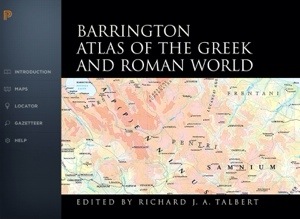
    Barrington Atlas App splash screen

    Princeton University Press has launched its iPad app version of the Barrington Atlas of the Greek and Roman World, as we noted here on Oct. 31. The app has been made available for $19.95 on iTunes. The Barrington Facebook page includes recent news and reviews about the release. Princeton provided a copy of the app for this review. Testing was done on a 4th-generation 128 GB iPad running iOS 7.0.4 after a clean restart.

    When the print version of the Barrington Atlas was published in 2000, the fruit of a multiyear international collaboration, it redressed a problem that had bedeviled the latter 20th-century: a lack of up-to-date, accurate, and visually informative/attractive (yes, I link those two attributes) maps for the classical world. Murray’s Small Classical Atlas, a short but distinguished accomplishment of Victorian cartography popular in schools, had seen its last update in 1917 (though reprints appeared through the 1950s).

    Hammond’s 1981 Atlas, from eBay

    The efforts of van der Heyden and Scullard (1962) and Hammond (1981) were useful as references, but their visual qualities (too few maps, and those reduced to atopographic colored line-drawings in the former; sepia monochrome in the latter) left much to be desired. The Facts-on-File Cultural Atlases released from 1980-1990 (“Greek World,” “Roman World,” “Egypt,” and “Mesopotamia and the ancient Near East”) were examples of the encyclopedia-style that prevailed in that decade, with lots of insets, photos, short descriptions, timelines and essays — an integrated approach that had many merits, but which were ultimately limited in sheer cartographic utility.

    Continue reading