• ROMARCH: Barrington Atlas of the Greek and Roman World iPad app; Review

    20131031-075153.jpg

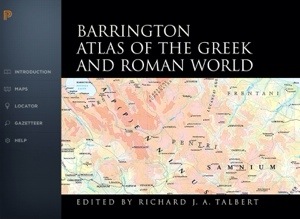
    Barrington Atlas App splash screen

    Princeton University Press has launched its iPad app version of the Barrington Atlas of the Greek and Roman World, as we noted here on Oct. 31. The app has been made available for $19.95 on iTunes. The Barrington Facebook page includes recent news and reviews about the release. Princeton provided a copy of the app for this review. Testing was done on a 4th-generation 128 GB iPad running iOS 7.0.4 after a clean restart.

    When the print version of the Barrington Atlas was published in 2000, the fruit of a multiyear international collaboration, it redressed a problem that had bedeviled the latter 20th-century: a lack of up-to-date, accurate, and visually informative/attractive (yes, I link those two attributes) maps for the classical world. Murray’s Small Classical Atlas, a short but distinguished accomplishment of Victorian cartography popular in schools, had seen its last update in 1917 (though reprints appeared through the 1950s).

    Hammond’s 1981 Atlas, from eBay

    The efforts of van der Heyden and Scullard (1962) and Hammond (1981) were useful as references, but their visual qualities (too few maps, and those reduced to atopographic colored line-drawings in the former; sepia monochrome in the latter) left much to be desired. The Facts-on-File Cultural Atlases released from 1980-1990 (“Greek World,” “Roman World,” “Egypt,” and “Mesopotamia and the ancient Near East”) were examples of the encyclopedia-style that prevailed in that decade, with lots of insets, photos, short descriptions, timelines and essays — an integrated approach that had many merits, but which were ultimately limited in sheer cartographic utility.

    Continue reading

  • Castel Rigone, Weeks 13-14: Bad Spirits and Good Spirits

    Re-blogging from Shades of Umbria, 3 Dec. 2013. This is the 10th in a series of posts on the ethics of competition, focusing on Castel Rigone Calcio, and part of the ‘Ethics of Combat‘ category on quemdixerechaos. This blog series completes a DePauw University Faculty Fellowship that examines how and why rules and customs develop for, and in, combat and competition.

    Pedar W. Foss's avatarShades of Umbria

    With three penalties missed in a row and three games in a row with a player dismissed for a red card, Castel Rigone was looking for their fortunes to change in week 14 vs. Aprilia.

    The previous week had brought on a strong performance away vs. ACD Foggia, but a missed penalty (this time by Di Paola, who had just substituted for Tranchitella) and a red card had squashed a comeback from 2-0 for the white-and-blues from Umbria (video highlights for both matches below).

    Much of the week’s papers concentrated on the maledizione, or “curse” that seemed to befall the club’s strikers from the penalty spot, a place where about 75% of penalties are normally successful (the figure drops to 69% under the pressure of an end-of-match penalty shootout and (eek) to 14% when a player has to score to keep a team alive in a shootout). Pressure matters…

    View original post 1,168 more words

  • Solomeo

    Re-blogging from Shades of Umbria, 29 Nov. 2013. This is the 9th in a series of posts on the ethics of competition, focusing on Castel Rigone Calcio, and part of the ‘Ethics of Combat‘ category on quemdixerechaos. This blog series completes a DePauw University Faculty Fellowship that examines how and why rules and customs develop for, and in, combat and competition.

    Pedar W. Foss's avatarShades of Umbria

    About two weeks ago, we visited Solomeo, a small town west of Perugia with a population (last census, 2001) of 436. Buses come just a few times a day, mostly for ferrying kids back and forth from school. Automobile is the most practical form of access. We went because Solomeo is the location of Brunello Cucinelli‘s factory and outlet store (photos of the factory here, located in the castello). Cucinelli is also a founder, and the patron, of Castel Rigone Calcio, about which I am continuing to write, and he supports local historical and cultural initiatives, such as the € 1.1 million consolidation and conservation of the Arco Etrusco, the ancient northern gate to the city of Perugia, which has been under scaffolding since we arrived.

    At a time of serious ongoing economic constraints in Italy, Cucinelli’s success is a bright spot for Umbria…

    View original post 1,946 more words

  • ROMARCH: American Academy in Rome, new summer school in architectural documentation

    SUMMER SKILLS COURSES IN ARCHAEOLOGY

    These intensive courses are intended to provide graduate students and other professionals in archaeology, history, classics and historic preservation (plus occasional upper-level undergraduate students) with hands-on training in skillsessential for contemporary practice. With opportunities to put into practice skills learned during the course, these courses are taught by specialists in the field and are offered in rotation in sequential years.

    2014 Program:
    Documentation and Analysis of Ancient Buildings

    2014 Dates:
    June 3-21, 2014

    Application Deadline:
    January 17, 2014

    Lead Instructor:
    Stephan Zink, Swiss Federal Institute of Technology (ETH) Zurich
    In collaboration with ETH Zurich (Institut für Denkmalpflege und Bauforschung, Prof. U. Hassler) and the Sovrintendenza Capitolina ai Beni Culturali.

    Description:
    Architectural remains represent the largest and most conspicuous body of material evidence for the study of Antiquity. At the same time, ancient buildings are fragmented and highly modified artifacts with long life cycles of construction, decay and reconstruction. The analysis and documentation of ancient buildings is thus an opportunity to understand buildings in time, to make sense of them as social and historical artifact and to address the issues of interpretative documentation and recording of the past.

    Continue reading

  • ROMARCH: Archaeological Field School, Heraclea Sintica, Summer 2014

    AMERICAN RESEARCH CENTER IN SOFIA SUMMER ARCHAEOLOGY PROGRAM, 2014

    ARCHAEOLOGICAL FIELD SCHOOL AT HERACLEA SINTICA WITH EXCURSIONS TO ARCHAEOLOGICAL SITES IN BULGARIAMAY 31 – JULY 7, 2014

    Deadline: February 15, 2014

    The American Research Center in Sofia (www.arcsofia.org) is pleased to announce the third summer Archaeological Field School at Heraclea Sintica (Bulgaria).

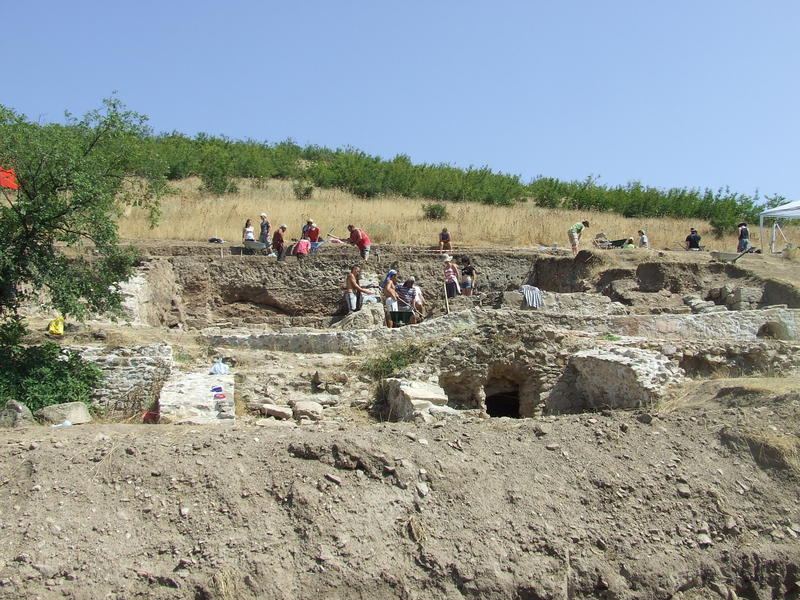
    Students will arrive in Sofia on May 31 and will spend two full days exploring the archaeology and history of this beautiful city. On June 3, the team will begin an archaeological journey, visiting sites and museums in Veliko Tarnovo, Kazanlak, Stara Zagora, Plovdiv and other smaller sites. We will arrive in the city of Petrich or Sandanski on June 7, the home base of the ARCS excavations at Heraclea Sintica. The excavation team will reside in a hotel in Petrich or Sandanski during the 4-week excavation season. Archaeological work is conducted Monday-Friday with additional excursions to southwest Bulgaria, northern Greece and Republic of Macedonia on Saturdays. The team will be accompanied back to Sofia on July 6, where they will stay one night, departing from Sofia on July 7.

    Continue reading

  • Castel Rigone, Weeks 11-12: Put Your Boots and Courage On

    Re-blogging from Shades of Umbria, 21 Nov. 2013. This is the 8th in a series of posts on the ethics of competition in soccer, focusing on Castel Rigone Calcio, and part of the ‘Ethics of Combat‘ category on quemdixerechaos. This blog series completes a DePauw University Faculty Fellowship that examines how and why rules and customs develop for, and in, combat and competition.

    Pedar W. Foss's avatarShades of Umbria

    In each of their last two matches, Castel Rigone has had a player dismissed from the game for accumulating two yellow cards. Within the club philosophy of fair play, they certainly don’t shy from physical play. After 12 weeks, they are in 12th place, just inside the play-out zone. Video highlights for both games can be found at the end of this post.

    Sunday, Nov. 10 saw a 1-0 loss to Ischia Isola Verde, a game in which Castel Rigone seems often to have been under siege. Castel Rigone would have equalized in added time, but Bianco’s freekick goal was disallowed, as three teammates were behind the Ischia defense and in an offside position at the time he struck the ball (whether they were ‘actively involved in play’ is an aspect of the offside rule that often invites argument; it currently states a player is offside if…

    View original post 1,238 more words