• ROMARCH: Archaeological Field School, Heraclea Sintica, Summer 2016

    ARCHAEOLOGICAL FIELD SCHOOL AT HERACLEA SINTICA2016

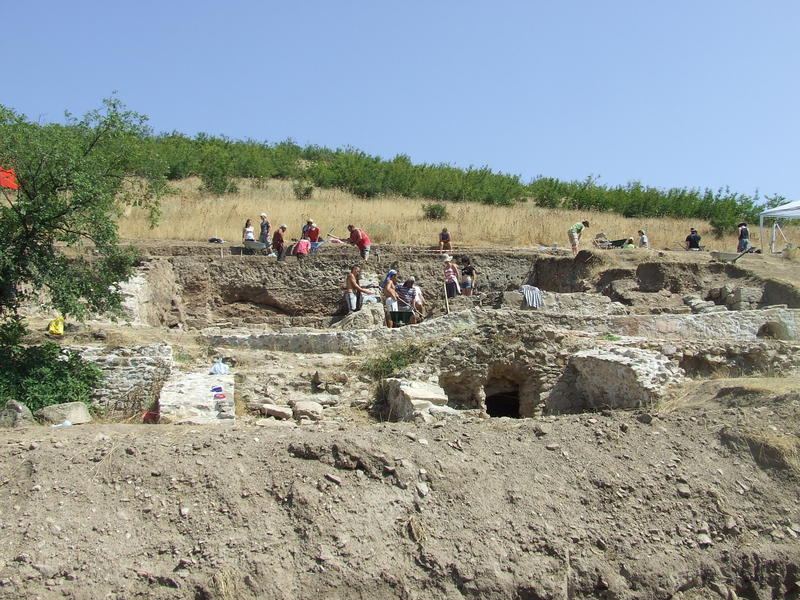
    The Hellenistic and Roman city of Heraclea Sintica is located near the  city of Petrich (SW corner of Bulgaria) which is situated 180 km south  of Sofia (Bulgaria) and 130 km north of Thessaloniki (Greece).

    Heraclea Sintica was founded as a Macedonian colony in the end of 4th c. BC. It was the main settlement of the Middle Struma (ancient Strymon) River region till the end of 4th c. AD. Since 2007 systematic archaeological excavations have been carried out.

    The current ArchBulg Field School will focus upon Late Roman civilian basilica (3rd ‒ 4th c. AD) and an Early Hellenistic building (end of 4th c. BC).

    Details about the summer school and the site can be found at:

    www.archaeologia-bulgarica.com

    Dr. Lyudmil Vagalinski
    director
    National Archaeological Institute with Museum
    BG-Sofia
    www.naim.bg

  • ROMARCH: 2016 Archaeological Field School: Trasimeno (Italy)

    The Trasimeno Archaeology Field School of the Umbra Institute in Perugia provides a curricular concentration in Archaeology and History based in Castiglione del Lago on the shores of Lake Trasimeno between Umbria and Tuscany.

    The Site

    Castiglione del Lago is a charming medieval town in Umbria, located on top of a small peninsula along the southwestern shores of Lake Trasimeno.  A member of the prestigious I Borghi più Belli d’Italia Association (The Most Beautiful Villages in Italy, www.borghitalia.it), Castiglione lies among renowned historical cities, such as Orvieto, Chiusi, Arezzo, Cortona and Perugia. All Field School participants will stay in Castiglione during the summer term, only a few miles away from Perugia and easily accessible either by bus or train.

    The Academic Program

    The Field School consists of two courses, one theoretical and one practical, both held in Castiglione del Lago. The program aims to provide students with a comprehensive overview of up-to-date theories and methods of archaeological research and fieldwork as applied to the civilizations that shaped the history and culture of central Italy. The Field School runs for 6 weeks, from the beginning of June through mid-July. Program dates for the summer 2015 will be May 29th (arrival in Italy) to July 11th (departure). 

    The course ARFW 350: Archaeological Field Workshop is an archaeology practicum. Students will work alongside professional archaeological staff to gain fundamental skills in archaeological research and apply them to the project.
    Course Credit: 3

    The course ARCL 340: Archaeology in Central Italy: The Etruscan and Roman Heritageintroduces students to the region’s history and heritage, and provides context for the archaeological research project.
    Course Credit: 3

    Both courses are non-prerequisite and mandatory. They include fieldtrips to various archaeological and cultural sites, including an overnight trip to Rome. Fieldtrips are designed to enhance student understanding of the territory’s history, while also providing the opportunity to study and visit neighboring archaeological sites and major museum collections.

    Click on the project website: http://www.umbra.org/academics/archaeology-summer/

    Continue reading

  • ROMARCH: Mellon Professor position, American School of Classical Studies at Athens 2017-2020

    ASCSA_emblemAmerican School of Classical Studies at Athens

    POSITION AVAILABLE

    ANDREW W. MELLON PROFESSOR OF CLASSICAL STUDIES

    Deadline: March 1

    The American School of Classical Studies at Athens seeks an established scholar with extensive experience in Greece for the position of the Andrew W. Mellon Professor of Classical Studies. The Mellon Professor organizes and conducts the academic program of the School in collaboration with the Director and the Assistant Director and must be able to provide a graduate-level introduction to the sites, monuments, museums and topography of Greece as well as advise students of the School in their research. In addition, as one of the officers of the School, the Mellon Professor participates in the operations of the School.

    The appointment is for a three-year term beginning July 1, 2017. Salary commensurate with rank and experience. Benefits include pension contribution, health insurance, travel budget, and housing on campus. The incumbent is not seeking a second term. The deadline for application is March 1, 2016. Send a letter of application detailing qualifications for the position as well as experience in Greece, research and pedagogical agendas, curriculum vitae, and three letters of reference to Professor Peter Krentz, Chair, Committee on Personnel, American School of Classical Studies at Athens, 6 – 8 Charlton Street, Princeton, NJ 08540-5232. Submit all application materials online at: https://ascsa.wufoo.com/forms/application-for-ascsa-mellon-professor/

    ASCSA is an EO/AA employer.

    http://www.ascsa.edu.gr

    Ms. Mary Darlington
    Executive Associate
    American School of Classical Studies at Athens
    6-8 Charlton Street
    Princeton, NJ 08540
    med@ascsa.org
    609-683-0800 Ext 11
    FAX 609-924-0578

  • Translating Pliny’s letters about Vesuvius, pt. 10. When in Doubt, Study

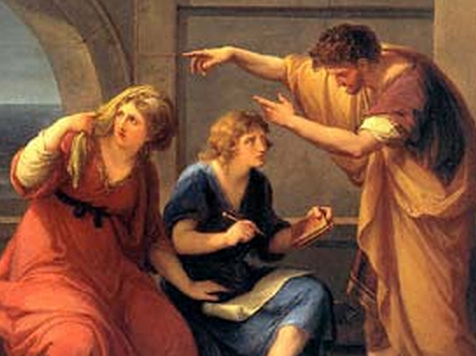
    Angela Kauffmann, Pliny the Younger and his Mother at Misenum, 79 A.D. (1785) Princeton University Art Museum (detail)

    Angela Kauffmann, Pliny the Younger and his Mother at Misenum, 79 A.D. (1785) Princeton University Art Museum (detail; see full painting below)

    6.20.4-6: When in Doubt, Study.

    This post belongs to a serialized translation and commentary of Pliny the Younger’s letters (6.16 and 6.20) to the historian Tacitus about the eruption of Mount Vesuvius in AD 79. This is the second installment for letter 6.20, and the tenth overall.

    This installment was completed with the contributions of DePauw LAT 223 students Jackson Hicks and Leigh Plummer in Fall 2014 and 2015.

    At this point in the story, Younger Pliny has spent a restless and bumpy night while his uncle the Elder Pliny has sailed off to investigate the eruption and try to evacuate refugees. He awakens to a dark day.

    4 Inrupit cubiculum meum mater; surgebam invicem, si quiesceret excitaturus. Resedimus in area domus, quae mare a tectis modico spatio dividebat.

    4 My mother burst into my bedroom at the same time I was getting up, about to rouse her, were she still asleep. We sat down in a courtyard of the house which was separating, by a modest extent, the sea from the buildings.

    In the Latin, noteworthy is the mixed conditional with a present-contrary-to-fact imperfect subjunctive (quiesceret) in the protasis, and a future-more-vivid future active participle (exciturus) in the apodosis, all set up by the imperfect of surgebam: “Right then I was in the process of getting up, about to wake [my mom] up (which I was definitely going to do), if she were [still] sleeping (which she wasn’t).” In the second sentence, the relative clause (area…quae) is straightforward.

    The first line is dotted with adrenaline vocabulary (inrupit, surgebam, excitaturus) that perks up the reader at the same time that the story’s main characters (Pliny and his mother) are waking up during the night to find each other out of mutual concern. There is a running theme in this letter about the anxiety of separation. Uncle Pliny is away (and at about this time in letter 6.16, also being roused [excitatus]); he “left behind” Young Pliny (relictus, from 6.20.1). Can mother and son stay together as the volcanic storm descends upon them?

    Continue reading

  • ROMARCH: New publications: Anatolia, Bulgaria, and Rome

    Archaeologia_Bulgarica

    Some recent publications:

    1. E. Lafli and S. Pataci (eds.), Recent Studies on the Archaeology of Anatolia, British Archaeological Reports, International Series 2750 (Oxford 2015). Recent discoveries from across Turkey, with an emphasis on Hellenistic-Byzantine material.
    2. Archaeologia Bulgarica ХІХ 2015 #2: from a Chalcolithic tell to Roman water-supplies to a Byzantine church.
    3. Molly M. Lindner, Portraits of the Vestal Virgins, Priestesses of Ancient Rome (Michigan 2015). Portraits of Rome’s Vestal Virgins as artistic documents and political vehicles.

    Please click through for contents and details.

    Continue reading

  • ROMARCH: 2016-17 American School of Classical Studies at Athens Programs and Fellowships


    THE AMERICAN SCHOOL OF CLASSICAL
    STUDIES AT ATHENS, STUDY IN GREECE 2016-2017

    ASCSA PROGRAMS AND FELLOWSHIPS
    The American School of Classical Studies at Athens, one of America’s most distinguished centers devoted to advanced teaching and research, was founded in 1881 to provide American graduate students and scholars a base for their studies in the history and civilization of the Greek world. Today, over 130 years later, it is still a teaching institution, providing graduate students a unique opportunity to study firsthand the sites and monuments of Greece. The School is also a superb resource for senior scholars pursuing research in many fields ranging from prehistoric to modern Greece, thanks to its internationally renowned libraries, the Blegen, focusing on all aspects of Greece from its earliest prehistory to late antiquity, and the Gennadius, which concentrates on the Greek world after the end of antiquity.
    Membership application to the ASCSA must be made online at http://www.ascsa.edu.gr at the same time you apply to any outside funding organization for work at the School.
    Please click through to learn about more than twenty available programs and fellowship opportunities.

    Continue reading